Green Architecture: the buildings that breathe like forests
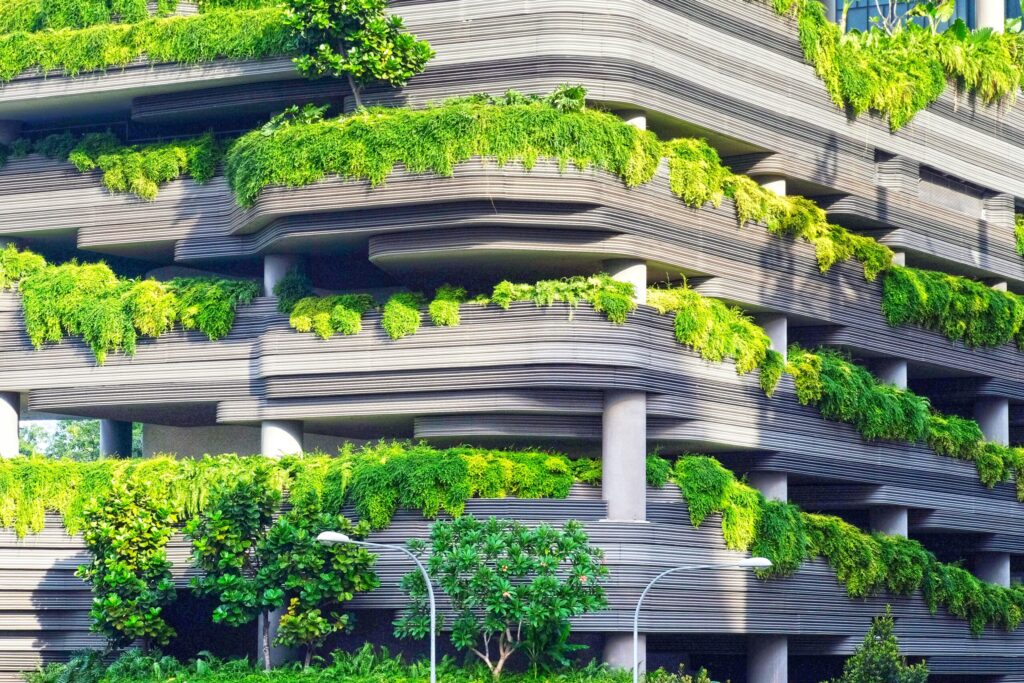
Architecture has always been a mirror of human power. From pyramids that defied the sky to skyscrapers that became symbols of modernity and capital, cities have long competed to touch the clouds with steel and glass. Yet today, a new paradigm is emerging: buildings that not only rise upward, but breathe inward and outward, like urban forests.
Green architecture is no longer a utopia reserved for futuristic sketches. It is a reality reshaping the urban cores of New York, Singapore, and Milan into laboratories of sustainability. And it is not only about aesthetics: these are skyscrapers capable of reducing carbon footprints, generating their own energy, and becoming vertical ecosystems.
✧ New York: gardens in the sky
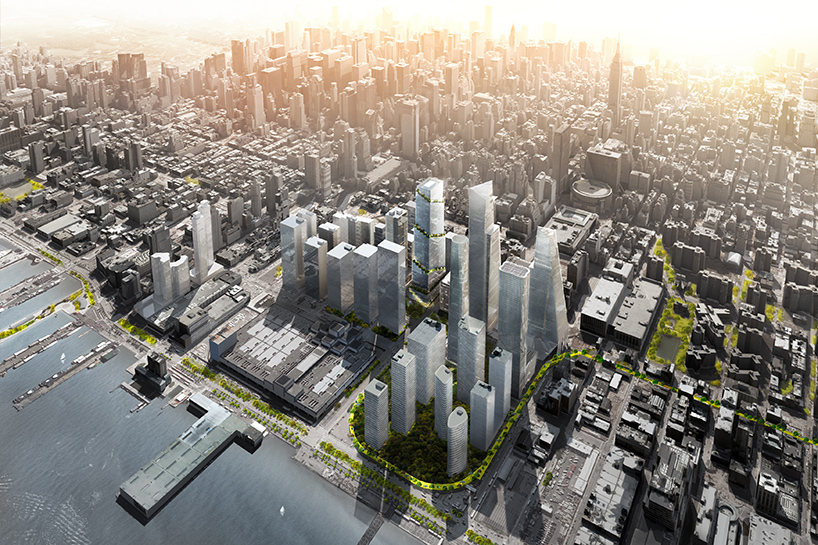
The city that never sleeps, famous for its skyline of steel, now attempts to drape it in green. Among the most iconic projects:
- The Spiral (Hudson Yards), designed by Bjarke Ingels Group, spirals upward with landscaped terraces on every floor. More than 13,000 plants transform the façade into a vertical lung, granting every office access to green space.
- Inspired by projects like One Central Park in Australia, New York has begun to integrate vertical gardens into residential towers, filtering air and lowering ambient temperature.
- Across Brooklyn and Queens, rooftops once forgotten are being reborn as solar fields and urban farms, providing fresh food while reducing heat.
New York, once the archetypal concrete jungle, is showing signs of becoming a living one.
✧ Singapore: pioneer of the city-forest
If there is a place where the fusion of nature and architecture is tangible, it is Singapore. Here, sustainability is not a trend—it is state policy.
- Marina One, with its “Green Heart,” hosts an interior forest of 37,000 square meters with waterfalls, tropical gardens, and natural ventilation, right in the financial core.
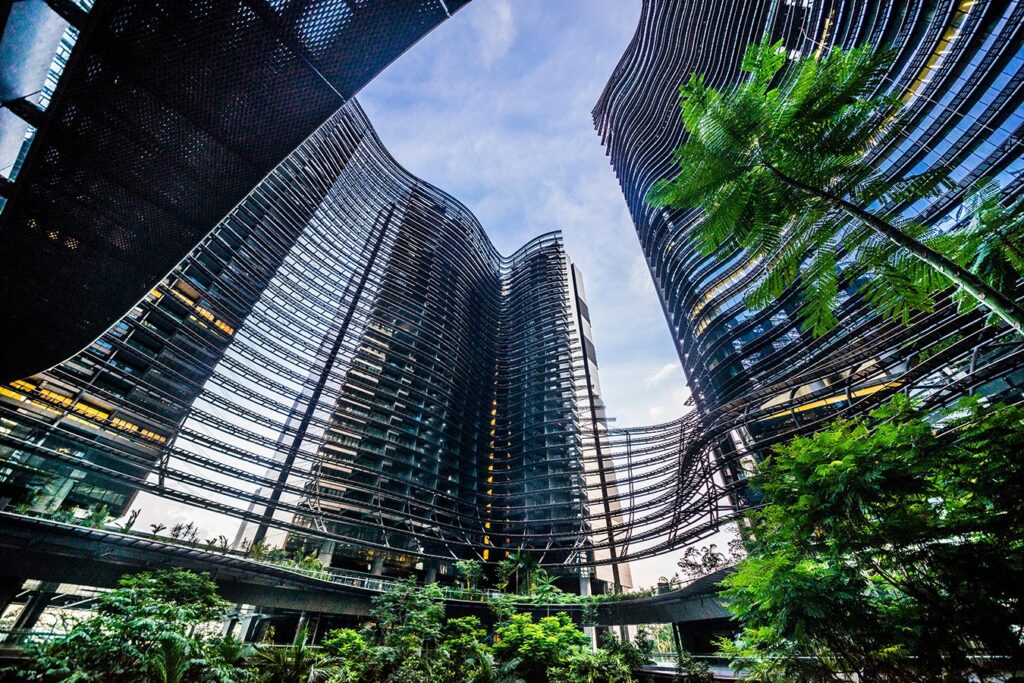
- Oasia Hotel Downtown, designed by WOHA Architects, wraps its crimson façade in more than 21 plant species, turning the tower into an oasis that reduces heat and draws biodiversity.
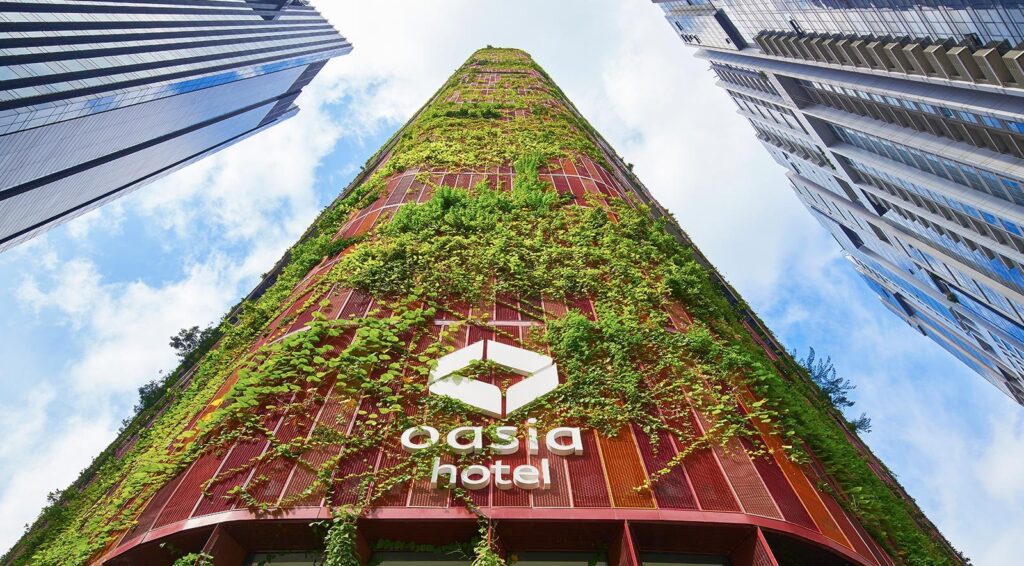
- PARKROYAL on Pickering is known as “the garden hotel,” with sky terraces spanning 15,000 square meters—almost equal to its built area.
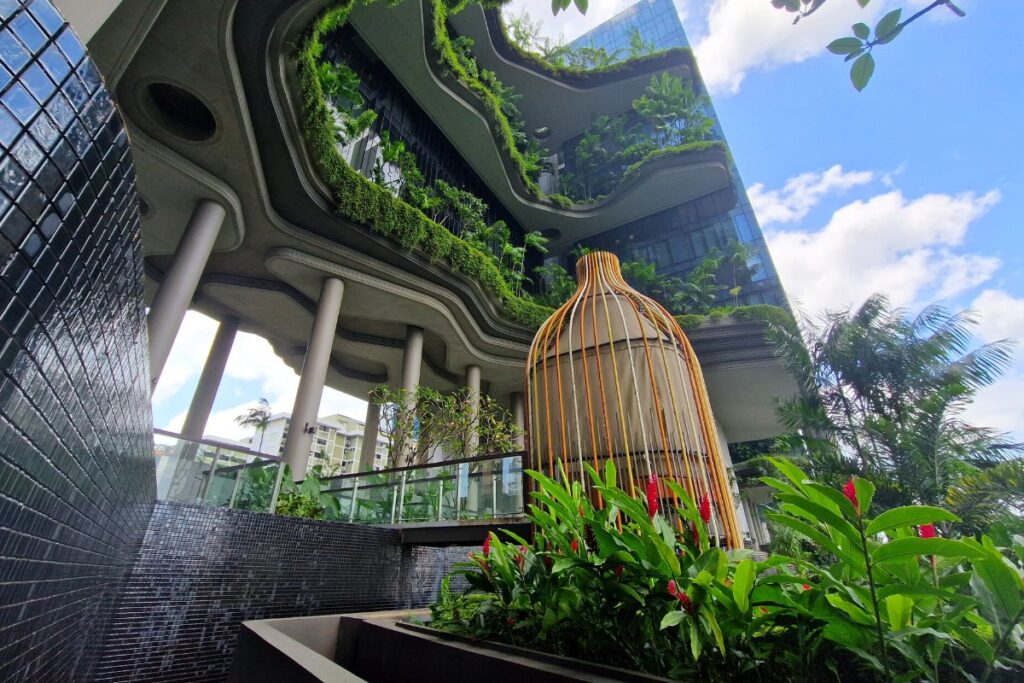
Singapore is not just constructing skyscrapers: it is designing habitats for birds, insects, and humans alike.
✧ Milan: the revolution of the Vertical Forest
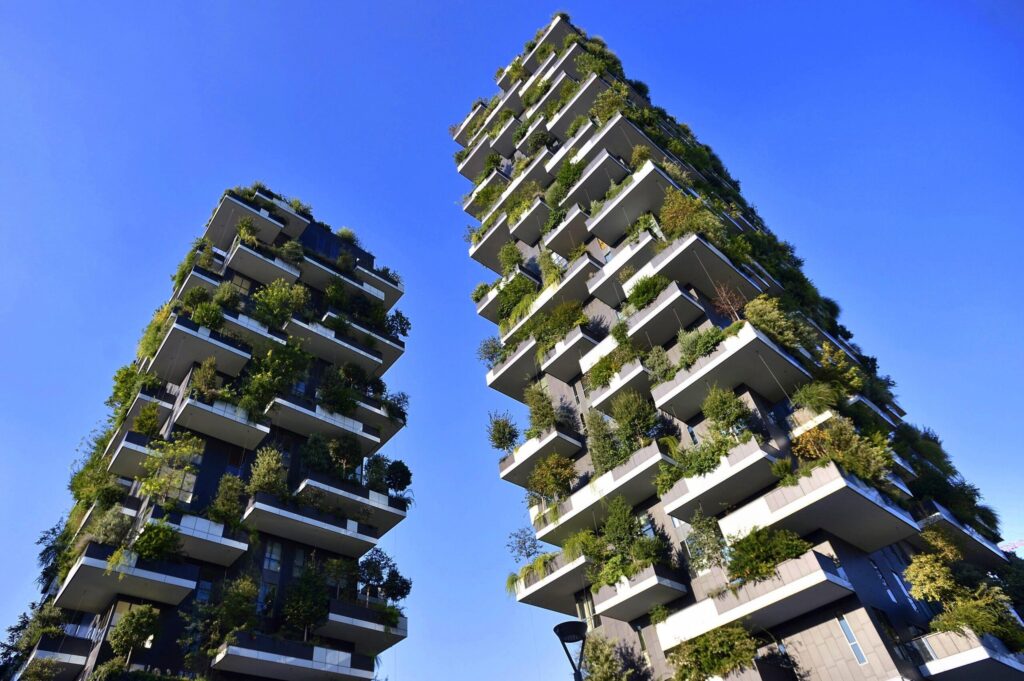
Europe is not falling behind, and Milan has become a global icon thanks to the Bosco Verticale (Vertical Forest), designed by Stefano Boeri. Two residential towers host more than 900 trees, 5,000 shrubs, and 11,000 flowering plants across balconies that climb 110 meters high.
- The Bosco Verticale reduces 30 tons of CO₂ per year, produces oxygen, and regulates residential temperature.
- It has inspired similar projects in Switzerland, the Netherlands, and China, where Boeri is exporting his vision of “forest cities.”
- Milan, once gray and industrial, now boasts one of the most celebrated examples of urban rewilding.
The Bosco Verticale is not only architecture—it is an aesthetic and ethical declaration about the future of cities.
✧ Beyond the green: solar energy and smart design
It is not enough to cover facades with plants. True green architecture thrives on energy innovation:
- Solar panels integrated into smart glass façades, generating electricity while filtering sunlight.
- Rainwater harvesting systems that irrigate vertical gardens.
- Natural ventilation strategies that reduce reliance on air conditioning, especially in tropical climates like Singapore.
- Modular, recycled construction materials that minimize environmental impact.
Today, luxury in architecture is not only about the skyline view—it is about living inside a building that allies with the planet.
✧ The new symbol of status
In the past, skyscrapers symbolized economic might: higher, shinier, more steel. Now the narrative is shifting. True prestige no longer lies in building the tallest tower, but the most conscious one.
A penthouse surrounded by green terraces in Manhattan, a hotel suite wrapped in foliage in Singapore, or an apartment in Milan that breathes like a forest… These redefine the concept of exclusivity.
Buildings that breathe are becoming the stage for a new sustainable luxury, where nature is not expelled from cities but invited back in.
✧ The future of cities
The trend points to an inevitable conclusion: the cities of the future will not be grayer, but greener. This is not about romanticizing concrete, but about reconciling it with life.
On a warming planet, forest-buildings are not architectural whims—they are urban necessity. Leaders who understand this are not just constructing buildings; they are constructing futures.
And perhaps, decades from now, when we look upward, we will no longer see glass towers reflecting a punishing sun, but suspended forests in the sky, reminding us that architecture, like luxury, can also learn to breathe.